For the past three years, you’ve probably been playing the waiting game.
Waiting for mortgage rates to finally cave. Waiting for the “inevitable” housing crash. Waiting for that perfect, quiet Tuesday when you can walk into an open house without twenty other buyers breathing down your neck.
But as we head toward the tail end of 2026, the silence in the market is starting to feel less like a “cool down” and more like the breath before a scream.
The biggest housing mistake of the next decade might not be buying too early—it might be waiting until everyone else decides it’s finally “safe” to jump back in. Here is why the “relief” you’ve been praying for might actually be a trap.
The Great American Freeze: Why Nobody Is Moving
The housing market isn’t broken because prices are collapsing; it’s broken because nobody can move.
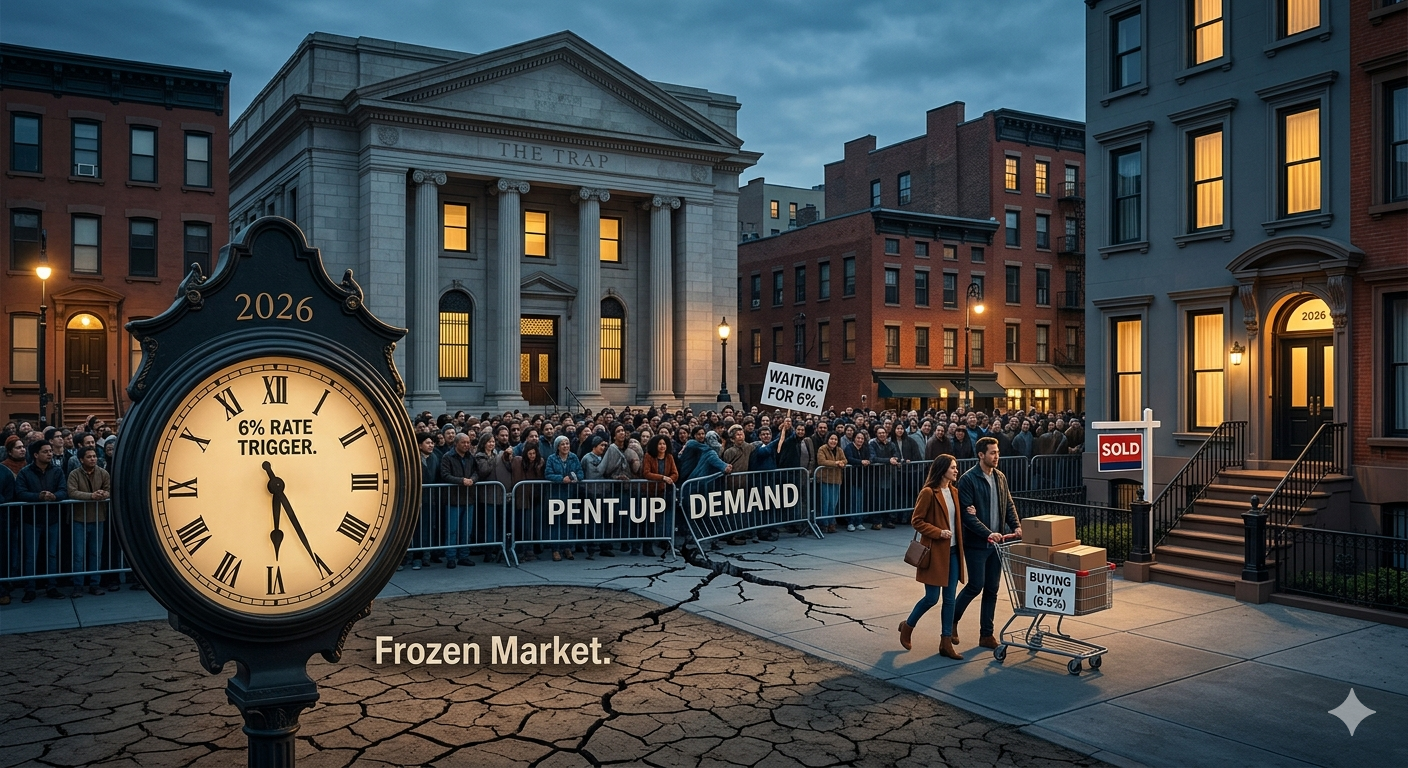
We are currently living through a “Frozen Market.” Millions of would-be buyers are sitting on the sidelines, cramped in apartments or delaying starting families, purely because of the psychological “rate lock.” On the other side, sellers are hugging their 3% mortgages like life rafts, terrified to list their homes and trade a low payment for a 6.3% reality.
This has created a massive reservoir of pent-up demand. Every month that passes without a rate drop, that reservoir fills higher.
The 2026 Trigger Event: The 6% Psychological Barrier
Most market analysts, including recent data from the NAR, suggest that the housing market is hyper-sensitive to the number 6.
As we move into late 2026, forecasts suggest mortgage rates may finally crack the psychological barrier, dipping into the high-5% range. To a renter who has been sidelined since 2022, a 5.8% rate looks like a miracle.
But here is the danger: You are not the only one watching the news.
The moment rates hit that “sweet spot,” the reservoir breaks. If millions of buyers who have been waiting for three years all rush the gates at once, we won’t see a “stable” market. We will see the return of the 2021-style frenzy: 50-person deep lines at open houses, waived inspections, and brutal bidding wars.
The Math of the Trap: Why Lower Rates Could Cost You More
It sounds counterintuitive, but a lower interest rate could actually make your life harder. Consider this scenario:
- Buying Now: You buy a home for $425,000 at a 6.5% rate. It’s expensive, but you have leverage. You can ask for repairs. You can take a weekend to think about it.
- Waiting for Late 2026: Rates drop to 5.7%. Great, right? Except now, ten other people are bidding on the same house. The price gets bid up to $460,000.
Even with a lower rate, your monthly payment on the $460k home is nearly the same—or higher—than the $425k home. The difference? You just lost $35,000 in equity and had to beg a seller to take your offer.
The Counter-Argument: Is This Just Hype?
To be fair, the “doom and gloom” isn’t guaranteed. There are signals that could favor the patient buyer:
- Rising Inventory: In some regions, active listings are finally climbing, which could put a lid on price spikes.
- Economic Headwinds: If the broader economy slows down, unemployment could cool that “pent-up demand” faster than low rates can heat it up.
- Regional Variance: What’s happening in Austin or Miami is not what’s happening in the Midwest.
The Decision: Marry the House, Date the Rate?
The buyers who “win” in the next cycle likely won’t be the ones who timed the absolute bottom of interest rates. They will be the ones who bought when they found the right house, while everyone else was still paralyzed by headlines.
The strategy many are betting on is simple: Buy the house while competition is low, and refinance the rate when the “Late 2026” dip actually happens.
The real question isn’t whether rates will fall. It’s what happens to your budget when millions of other buyers realize they’ve all been waiting for the exact same moment.
What’s your move? Are you holding out for the 5% range, or are you tired of the sidelines? Drop a comment below with your city—let’s talk about what’s actually happening on the ground in your market.